
Consuming Love
desire and the fractured self in Better Call Saul

Love bade me welcome. Yet my soul drew back
Guilty of dust and sin.
But quick-eyed Love, observing me grow slack
From my first entrance in,
Drew nearer to me, sweetly questioning,
If I lacked any thing.
-George Herbert, Love (III), beginning fragment
While pregnant with my first child (over four years ago, now!) I skim-watched seasons 1-5 of Better Call Saul. The 6th season had not come out yet, and once it did, I was too wrapped up in life to watch it. I recently went back and rewatched it from the beginning, and I just watched the series finale tonight. It’s probably the best love story I’ve ever seen.
It is, of course, not a conventional love story. It’s not romantic, first of all. Although the two leads are in a romantic relationship for most of the show, it is decidedly void of sentiment, eroticism, even basic flirtation. But it IS a love story, as others have recognized, and over the course of six seasons manages to portray love between two people for what it is, at its core: a paradox.

If you haven’t seen the show (which is a spin-off of/prelude to Breaking Bad) and don’t plan to, or if you don’t mind spoilers (can you spoil a four+ year old show?), here’s mostly what you need to know to follow along here: The two leads, Jimmy McGill (Bob Odendirk) and Kim Wexler (Rhea Seehorn), are lawyers who begin the show in an on-again-off-again relationship which has turned into a marriage by the last season. While Kim is a brilliant young lawyer working her way up to a partnership at the law office that trained her, Jimmy (“slippin’ Jimmy”) is a loser. A scam artist with a dubious J.D. obtained through a correspondence school, Jimmy lacks any apparent skill aside from the ability to fleece almost anyone, and an indefatigable drive to obtain what he wants. Jimmy’s interest in becoming an above-board lawyer at a real firm waxes and wanes throughout the show, but eventually dissolves completely as his practice turns almost exclusively to the use of legal loopholes to keep criminals out of jail. Some of these criminals happen to be members of warring cartel factions, marking the beginning of the Jimmy’s descent.
But despite the high drama of the show’s big legal cases, the cartel violence, and Jimmy and Kim’s ever-changing employment situations, the show is a love story. Specifically, a story about how love consumes us, for better or worse.
For Worse
Jimmy and Kim are bad for each other. The first five seasons of the show make this excruciatingly clear. Each uses the other to prop up their own false identity. Kim, who sees herself as an Atticus Finch who fights for the oppressed, is in reality a legal assistant pushing papers, and later banking lawyer helping the rich get richer. Her relationship with Jimmy works as an outlet into which she can pour her compassion and generosity without having to take any actual career or financial risks. For his part, Jimmy’s own false self-conception as a lawyer fighting for the little guy against The Man is partly kept alive by his close ties to Kim’s legitimate and reputable legal practice.
While their differing views on what constitutes “best practice” in the world of jurisprudence results in some relational frictions, they both fall comfortably into the roles of respective enablers. Further, they do all these things, not in spite of, but because of their love for one another. In a pivotal episode, after both have become emmeshed in a messy and wildly complicated scheme to ruin another lawyer’s reputation, Kim literally asks Jimmy, “Are we bad for each other?” It’s an interesting scene because the viewing audience feels the answer so overtly—YES! But why? Kim loves Jimmy and genuinely wants to see him flourish, though this often comes at the expense of herself and possibly everyone else around him. Jimmy, as the show portrays in heartrending vividity, wants nothing more than to be permanently united to Kim. Yet, this results in him abandoning petty crime and small-scale scams for high-rolling cartel services in an attempt to use wealth to prove himself worthy of Kim’s love.
Vice as the Enemy of Union
Aristotle is famous for arguing, in book VIII of his Nicomachean Ethics, that vice is an impediment to true friendship. I have always found it hard to teach this passage, because the reasons Aristotle gives for his claim that very vicious people cannot truly be friends with one another are not extraordinarily convincing on their face. Friendships of utility end when the utility ends, friendships of pleasure end when the pleasure ends, sure. But two questions arise: what if the utility/pleasure never do end? and why do these relationships seem to go wrong even when the utility/pleasure are still there?
For a long time, it was not quite clear to me what it was about badness (call it what you will: badness/vice/wickedness/evil/sin) that inherently prevented unity with another. Even if one assumes a deeply neoplatonic metaphysic—on which Goodness and Being, being a single substance, entail that the bad is void—could two people not at least be united in their mutual embrace of the void? Aristotle considers the possibility of union over a mutual love of wickedness, but argues that such a union is fleeting because the wicked person lacks “steadfastness”—they change as the wind blows, doing whatever will serve their own desires. But the cause of this lack of steadfastness is the deeper reason that wickedness and union are in conflict, which prevents even temporary unity among friends or lovers. Before wickedness (vice/evil/immorality/sin) can divide two people, it divides the self.
In Better Call Saul, as the schemes ramp up from clever-but-discount legal services to full-blown fraud and criminal abetment, both Kim and Jimmy undergo deep divisions of the self. The show uses visuals in clever ways to allude to this:
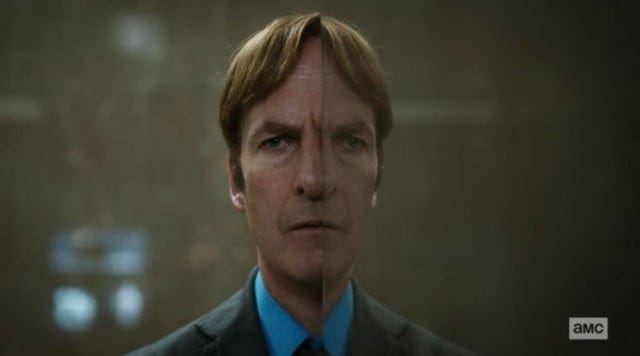
For Jimmy, this division is comically literal. Hoping to avoid the wholesome image garnered from his former work composing wills for the elderly, he changes his name to (for an additional layer of humor and overt irony) Saul Goodman (GOODman!). He gets a decrepit new office in a seedy strip mall, then divides it in half and converts the waiting room into a cozy lounge area. Even his work wardrobe becomes a ridiculously flamboyant contrast to his regular clothing.
Kim’s divided self is more subtle but just as detrimental. Her actual job becomes an after-thought to the pro bono public defense work she picks up as a way of trying to fulfill her dream of being a virtuous lawyer, while still raking in the money and accolades of her less-admirable work with big banking. She and Jimmy are stretched so thin by their double-lives that the time they have to spend together dwindles, eventually, down to nothing, and they become ships in the night who happen to share the same electric juicer. They recognize this, and as the dubiousness of their respective employment situations increases, and they begin to wonder out loud if they are bad for each other, the solution they settle on during a moment of heated and grieving desperation is not separation. Rather, they claw after union with even greater intensity. They get married.
Cannibal Love
“We love someone, that is to say, we love to drink his blood.” -Simone Weil, Supernatural Knowledge
The idea of love as something like consumption is ancient. In Plato’s Symposium, Socrates argues that love is the recognition of a lack of some good in oneself, and the subsequent desire that arises when we see this good in another. Aristophanes takes this a step further, positing that the acquiring of the beloved amounts to the reconstitution of the whole person—a round two-headed being. Individuals, mere halves of wholes, spend their lives wandering around in search of their literal other halves.
The French philosopher Simone Weil drew an even more direct comparison. In describing love as the desire to cannibalize the beloved, she points to a fundamental paradox of human life: the opposing natures of beholding and eating.
“Man’s great affliction, which begins with infancy and accompanies him till death, is that looking and eating are two different operations. Eternal beatitude is a state where to look is to eat. That which we look at here below is not real, it is a mere setting. That which we eat is destroyed, it is no longer real. Sin has brought this separation about in us.” (Gravity and Grace, “Contradiction”)
We experience this constantly, even if we don’t notice it. I visit an art museum, and am overcome by the desire to take photographs of Botticelli’s work. Doing so is, of course, stupid: there are far better quality photos of it available online, and my hastily-snapped phone photo will only do a disservice to the grandeur of Primavera, stripping it of everything that made it so overwhelming in the first place. Desire, beauty, the recognition of the good, moves us to do the one thing that will deprive us of the object of our desire. We are moved to consume it.
It makes sense that Kim and Jimmy would grasp at union in a kind of famished frenzy, despite the continuously disastrous results, because each does possess a good that the other lacks. Kim is the moral compass that provides Jimmy with glimpses of goodness, and without which his vices become grotesques, choking out pangs of conscience like an invasive plant chokes out flowers. Jimmy, for his part, has the guts, determination, and follow-through to pursue what he wants even when it is risky, and enough disdain for high-profile lawyers to lack concern over his reputation among them. He is a risk-taker, and his boldness draws Kim to him because it is precisely this sort of courage that she lacks, and this lack keeps her pushing papers for the wealthy elite rather than fully committing to her public defender dream. They chase what they respectively lack in the other ferociously, ravenously. They consume them. And when they look up from eating, they find that all the goods they sought have disappeared.
Season 6 flips the script on the characters, positioning Kim as the mastermind and captain of a grand scheme to destroy the reputation of a former colleague, in an attempt to force a class-action settlement from a distance. While Jimmy is involved, he is primarily the hired help—the hired “slip” if you will—carrying out her wishes. He is, in fact, more wary of the plan than Kim, whose conscience has taken a long holiday. Jimmy, too, has had his fundamental goods consumed in his relationship with Kim, becoming more risk-averse and even encouraging Kim to keep her law firm job and give up her pro bono work for the sake of financial security.
The 19th century Danish philosopher Søren Kierkegaard, writes the following in his Works of Love:
“The one in whom love is a need certainly feels free in his love, and the very one who feels totally dependent, so that he would lose everything by losing the beloved, that very one is independent. Yet on one condition, that he does not confuse love with possessing the beloved.”
This last line must be a bit tongue-in-cheek, because SK knows very well that, in fact, almost everyone does make this confusion. Love and the drive toward possession, toward consumption, not only often go together, they are frequently indistinguishable to us. But this is our mistake, arising from the impurity of our hearts. And it is, for Kierkegaard, a mistake that 1) binds us to swiftly-shifting temporal realities that will certainly let us down, and 2) prevents our love from becoming eternalized and, therefore, allowing us to relate ourselves to this relation between ourselves and what we love. When our love is driven to possession and consumption, we lose what we eat, and then—because we loved it and therefore related our selves to our relation to it—we lose ourselves.
By the middle of the last season Kim and Jimmy have loved, feasted, and left nothing but an empty table (and irremediable chaos and violence.)
For Better
“The beautiful is a carnal attraction which keeps us at a distance and implies a renunciation. This includes the renunciation of that which is most deep-seated, the imagination. We want to eat all the other objects of desire. The beautiful is that which we desire without wishing to eat it. We desire that it should be.” (Simone Weil, Gravity and Grace, “Beauty”)
It would have been easy to end the show on an artistic lack of hope, a jaded scowl or pitying smirk in the general direction of love and lovers. BCS chose not to do this, and I’m glad they didn’t. If they had, they would have failed to show the full possibilities of love. For in love, we may desire, devour, and annihilate the beloved; but we may also love without devouring.
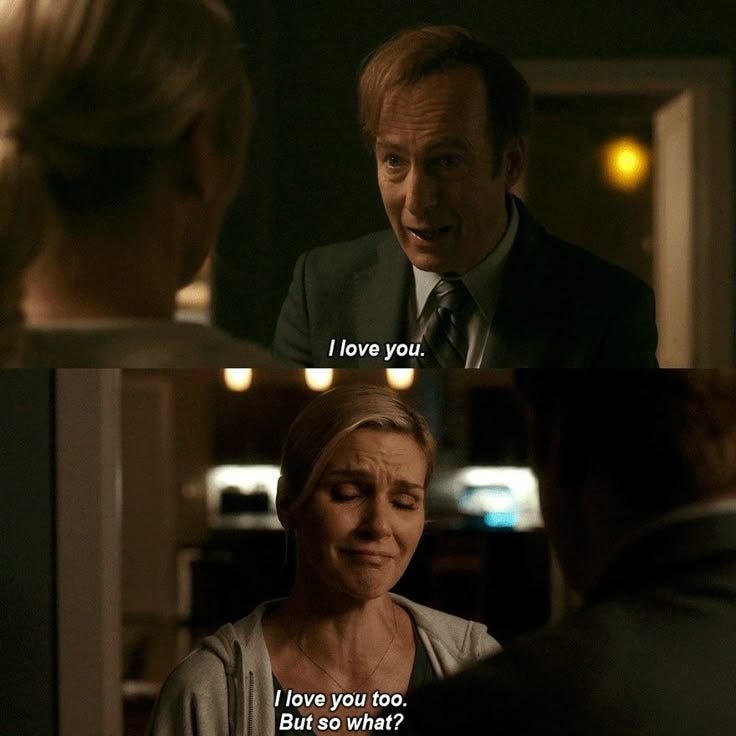
At the peak of the cartel violence in which they have become emmeshed, a colleague of Kim and Jimmy’s (Howard) is killed in their living room as a result, they are very nearly killed by the same killer, and the murder is hastily covered up by one of the rival cartel factions. It is staged as a suicide, which works convincingly since Kim and Jimmy had been working for weeks to frame Howard as a cocaine addict. Kim and Jimmy will be fine, and are free to move on with their lives—all they have to do is keep their stories straight and their heads low. But this incident ends up being the final straw in their constantly-strained relationship. Kim packs up her things and tells Jimmy she is leaving. Together, she says, they are “poison.” In the heat of the breakup argument, Jimmy tells Kim that he loves her, and she responds that she loves him as well, “But so what?”
This is, significantly, the first “I love you” they have exchanged in the entire show, although their love has been obvious from the first season. But the moment is deflated instantly by Kim’s questioning of the significance—or sufficiency—of love. Love is not a reason to stay together. Neither is happiness, though Jimmy tries to convince her to stay by repeating how happy they make one another. In the wake of what has happened, neither happiness nor love provides sufficient grounds for a continuing relationship. Kim leaves, files for divorce, and moves to Florida. Love looks impotent, even laughable, after the murder, like a childish dream now permanently out of reach.
The second half of season six makes a drastic aesthetic shift, as well as a leap forward in time. Focusing primarily on the life of “Saul Goodman” post-Breaking Bad, nearly seven years after the end of BCS, the episodes primarily follow Jimmy’s life in hiding, and are shot in black-and-white. Jimmy is a fugitive wanted for the laundry list of crimes related to helping Walter White build his meth empire. He is living in Omaha under an alias, and working at Cinnabon, and trying to suppress his drive to scam people. He is totally alone. Kim, too, has taken up an extremely bleak existence working at a sprinkler company, dying her hair an unflattering shade of brown, and having conversations with her new boyfriend about mayonnaise.
Out of the blue one day, Jimmy calls Kim, under the auspices of wanting her to know he was still alive. Kim does not talk to Jimmy for long, and has only one thing to say: “you should turn yourself in.” He scoffs, and throws the challenge back at her: why doesn’t she turn herself in for the role she played in Howard’s death and subsequent cover-up? They hang up. Then Kim takes Jimmy up on his challenge, and she turns herself in. She does so with lawyer-like thoroughness, meticulously typing out her full confession and having it notarized, before presenting it to Howard’s still-grieving widow. Simultaneously, in Omaha, Jimmy has finally been caught by the FBI. Though he is facing compounding sentences adding up to hundreds of years of prison time, he puts his fast-talking (/lying) skills to good use and manages to secure a deal with prosecutors of only seven years. The judge calls it the most generous plea deal she’s ever seen in her life. But when Jimmy learns Kim has confessed, he tells the prosecutors that he has new information that concerns her, that he wants to discuss at his trial. On the day of the trial, with Kim in the audience, Jimmy stands in front of the court and confesses.
He confesses everything. The story he’d spun to obtain the seven year plea deal is obliterated. He confesses to even more crimes than he is being tried for. His lawyer is dismayed, and the prosecution is befuddled. In the end, he is sentenced to 84 years in federal prison—he will die behind bars. He looks behind him and throws Kim a smile.
Although the final episode of the show has almost perfect critical reviews, a lot of the viewing audience found this moment unconvincing. Why does he do it? Why give up the rest of his life when he already had a deal to serve seven years? I’ve read a lot of hypotheses: maybe he was trying to impress Kim, maybe he was looking for a way to see her one more time, maybe he just needed to give himself an extra challenge, or maybe he just couldn’t live with himself any longer. But I really think all of them fail to get at what’s really going on in that moment, which is that for the first time in his life, he actually can live with himself.
The seven year deal was premised on a story of Jimmy’s criminal activity that was wildly false. But Jimmy seemed content to go this route until he heard that Kim had confessed her own misdeeds. Kim was no longer disunified. In confessing everything that happened, she had managed to glue the two halves of her life back together into a coherent single narrative once more. What motivates this move is not desire, but necessity; there is simply no other way forward. What is more, her choice changes the stakes for Jimmy. No longer are they both do-badders on the run (from themselves or from the authorities), a state that binds them together as much as it keeps them apart. Now that Kim has acknowledged and accepted the whole reality of her life, until Jimmy does the same, an unsurpassable division exists between them.
What has motivated Jimmy from the beginning of the show, aside from his compulsive scheming and defrauding, is the desire for union with Kim. Early on, viewers see him fantasizing about working with her in a law office of their own, doodling logos where M and W (McGill and Wexler) are intertwined. In this moment, in the finale of the show, Jimmy finds himself in a position where the only way to have any sort of real union with Kim is to do the one thing that will make physical union—an actual life together—impossible. He has to publicly face who he is, in the full light of day. Rather than continuing to chase a fantasy of future life, he has to, in Weil’s words, “Desire that it [everything that truly is] should be” (emphasis mine). And in doing that, he guarantees himself a lifetime of federal imprisonment.
Felix Culpa
Love is insufficient, but it is not impotent. Even the person who feasts and destroys sees a vision of the good before he does so. And it is this vision that, once it has taken root in a heart, may catalyze the transformation from a fragmented self to a hole. The rebuilt whole is not exactly the same as the person before the breech, and there is a kind of paradoxical goodness that can come of it, although much too is lost. In prison, the disparate parts of Jimmy’s life begin to come together. He is Jimmy, but he is also Saul. He uses his bread-making skills, gained from his work at Cinnabon, to make bread in the prison kitchen. And in the last few moments of the show, Kim comes to visit him. This final scene mirrors the very first scene of the show that Kim and Jimmy are in together: they lean against a wall and share a cigarette. In this final scene, they speak sparsely and casually, joking about Jimmy’s 86 year prison sentence and the possibility that it might be shortened for “good behavior.” There is a kind of “starting over” that is like a felix culpa—both worse and better than the original, but with the hope for something the original could never have fully attained.
Still, it is certain that Kim and Jimmy do not attain anything like a happy ending even if they are, in a sense, better off than before. As alluded to in an earlier quote, Weil sees the enmity of love and consumption, not as something essential to their natures, but as an unfortunate byproduct of our fallen and contingent nature. “Eternal beatitude” she claims, “is a state where to look is to eat.” Eternal beatitude is a state where the vision itself nourishes, without the need for consumptive devouring. The bittersweet ending of BCS points toward this idea that the things below, so to speak, are faint shadows of how they ought to be. These shadows are not enough to nourish us, themselves. But sometimes they are enough to bring us back to ourselves, to show us how to love with freedom through contentment with hunger.
You must sit down, says Love, and taste my meat:
So I did sit and eat.
-George Herbert, Love (III), ending fragment.
Very nice, so is it fair to say you think Kim and Jimmy's love was inherently tragic? That is, had they been healthy they'd have no basis of romantic interest?
This is terrific, Megan. I haven’t ever watched Better Call Saul, but I watched Breaking Bad and I’m currently writing on love and beauty (engaging the works of Weil and SK that you discuss here), and I think this is just an amazingly good reflection piece. It makes me want to watch the series and then re-read your analysis. (I’ll probably re-read it anyway…it’s full of interesting ideas and insights.)